Ghana’s Toxic Landfills of Unwanted Clothing
When you drop off a bag of used clothing at a donation center, you might imagine it ending up in the hands of someone in need. But the truth is much darker: much of our discarded fashion doesn’t get reused—it gets shipped across the ocean to become someone else’s problem.
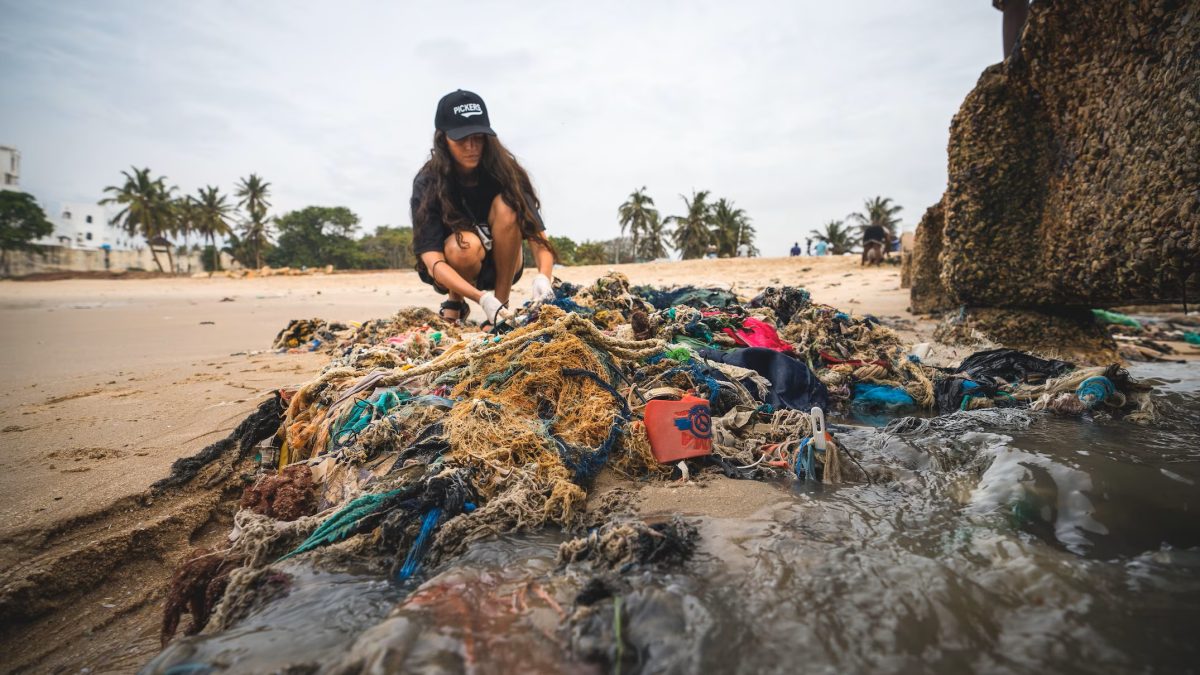
And for Ghana, one of the world’s largest recipients of second-hand clothes, the price is high: polluted coastlines, toxic landfills, and a crisis of waste that isn’t theirs to begin with.

Ghana’s Kantamanto Market: A Hub Under Siege
At the heart of the issue lies Kantamanto Market in Accra, the largest second-hand clothing market in West Africa. Each week, an estimated 15 million garments are imported into Ghana from the UK, U.S., Europe, and Australia. Every two weeks, that number totals 30 million—one garment for every person in the country.
While the market is a place of hustle, resilience, and community ingenuity, it cannot keep pace with the tsunami of cheap clothing flooding in. Most garments are low-quality fast fashion items—unsellable, synthetic, and disposable.
It’s estimated that 40% of all imported clothing ends up in landfills, illegal dumpsites, or waterways, where it pollutes the soil, leaches toxic dyes, clogs drainage systems, and poisons the ocean.
Fast Fashion’s Global Waste Spiral
This crisis didn’t happen in a vacuum. It’s the result of decades of unchecked overproduction and overconsumption.
- In 2014, global garment production topped 100 billion items.
- By 2030, that figure is expected to surpass 200 billion.
- Consumers now buy 60% more clothing annually than they did just two decades ago.
- Yet these garments are kept only half as long, thrown away to make space for the next fleeting trend.
With disposal systems overwhelmed in the Global North, surplus garments are offloaded to countries like Ghana—not as charity, but as fashion waste colonialism.
These discarded clothes bring with them enormous environmental costs:
- Massive water overconsumption in production
- Toxic dye runoff and water pollution
- A skyrocketing carbon footprint from global shipping and synthetic materials
And in places like Ghana, where environmental infrastructure is already under strain, the results are devastating.
Situations and research: | Global apparel market – key statistics
Burned, Buried, or Dumped: A Nation Suffocating in Clothing Waste
Synthetic materials like polyester, acrylic, and nylon don’t biodegrade. They fill landfills, burn into the atmosphere, or end up tangled along Ghana’s coastline—a vibrant natural world smothered in plastic fabric.
As Solomon Noi, Accra’s Director of Waste Management, shared:
“I’m not sure they’ve ever been conscious to ask, where is the final destination of that thing they are discarding… But if they come here, like you’ve come, and you see the practicality for yourself, then they will know that, no, we better take care of these things within our country and not ship that problem … to other people.”
Our Materials: Woven with Intention
At True Nature, we choose fabrics not only for how they feel—but for how they vibrate. Every thread is selected to support your energy, your movement, and the Earth itself.
We work exclusively with natural, breathable, and biodegradable fibers, including:
-
Bamboo – Soft, sustainable, and naturally antimicrobial
-
Cotton – Pure, gentle on skin, and widely renewable
-
Linen – High-frequency, cooling, and ancient in origin
-
Silk – A symbol of elegance and vibrational harmony
-
Signature Blends – Engineered for movement, frequency, and functional beauty
✧ CloudWeave
A featherlight cotton-linen blend crafted for breathability, softness, and energetic uplift. Designed to move with you—and return to the Earth with grace.
✧ SolunaThread
Our elevated organic cotton and silk blend—luxurious, radiant, and harmonized with the natural frequency of the human body.
✧ BambooFlex
A fluid, high-stretch bamboo and Lycra blend that offers unrestricted movement without compromising on natural feel. Perfect for activewear and warm climates where plastic-free flexibility matters.
✧ EtherealSilk
A delicate blend of 70% Silk and 30% Plant Viscose, offering an ethereal drape and luminous finish. This is silk reimagined—with minimal synthetic interference, honoring softness and sustainability.
We believe what touches your skin should uplift your spirit, awaken your senses, and leave no trace of harm behind.
This is clothing as ceremony—made in alignment with nature, energy, and truth.
We believe what touches your skin should uplift your energy—not burden the Earth.
What You Can Do
✨ Be curious. Ask: Where does my clothing come from? Where does it go when I’m done?
✨ Choose fewer, better garments made with natural, high-frequency materials.
✨ Support brands that take responsibility for their supply chain and design with the end in mind.
✨ Share what you’ve learned. Awareness is a first act of resistance.
✨ Demand policy changes to regulate fashion waste exports and hold brands accountable for their overproduction.
Learn more at Detox My Fashion
We are not powerless. Every purchase is a vote. Every garment is a story. And the story we choose to tell can be one of healing, integrity, and true connection—with our bodies, our clothes, and our planet.
Let’s end fashion waste colonialism and return to clothing as a sacred, sustainable art.